
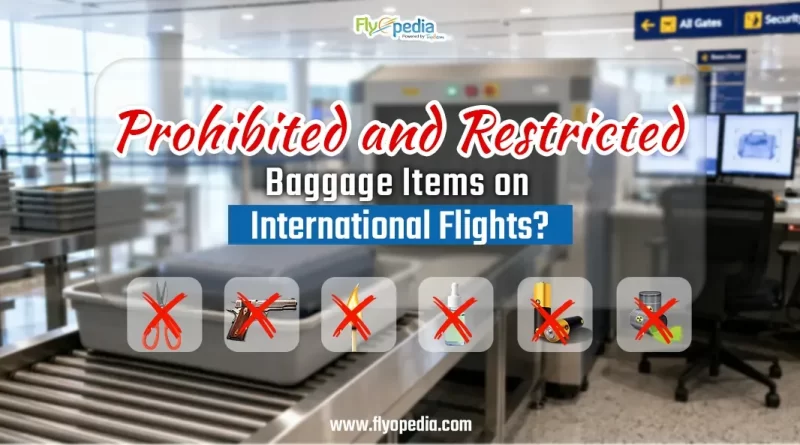
Prohibited and Restricted Baggage Items on International Flights
Packing for an international trip always feels easy at first. Then, you start second-guessing everything. Does the power bank go in your backpack or the checked bag? Is perfume even allowed in a cabin bag? Will security stop you over something buried at the bottom of your suitcase? Almost everyone runs into these same questions before a flight.
However, most packing mistakes are avoidable once you know the difference between cabin baggage restrictions and checked baggage restrictions. A few minutes checking the restricted items list ahead of time saves you from delays at security, confiscated items, or a surprise baggage fee you didn’t see coming.
So, before you book international flights from USA to India, use this guide to understand airline baggage rules and pack accordingly before your trip.
Restricted Baggage Items on International Flights
International airlines follow aviation safety regulations that block passengers from carrying dangerous goods, explosives, firearms, flammable liquids, corrosive chemicals, and certain lithium batteries. Everyday items like power banks, perfume, medicine, and food get through, but only under specific conditions.
| Item | Carry-on | Checked Baggage |
| Power Banks | Yes | No |
| Laptop | Yes | Yes (switched off) |
| Mobile Phone | Yes | Yes |
| Medicines | Yes | Yes |
| Perfume | Within liquid limits | Yes |
| Alcohol | Limited | Limited |
| Firearms | Restricted | Airline approval required |
| Fireworks | No | No |
| Explosives | No | No |
| Loose Lithium Batteries | Yes | No |
One thing you should remember is that airport security rules set the minimum safety standards. Individual airlines can and do apply stricter baggage rules on top of that, so check your specific carrier before assuming the general rule applies.
Read More: United Airlines Baggage Allowance
What Items Are Not Allowed in Carry-On Baggage?
Airport security agencies worldwide restrict anything that could threaten passenger safety or double as a weapon inside the cabin. Knowing exactly which items are not allowed in carry-on baggage saves you from a confiscation surprise at the checkpoint.
Liquids Above the Permitted Limit
This is probably the most misunderstood part of international baggage restrictions. Most airports cap liquids, gels, creams, aerosols, and pastes in cabin baggage at 100 ml (3.4 oz) per container, all packed inside one clear, resealable bag, shampoo, perfume, lotion, toothpaste, hair gel, sunscreen, liquid cosmetics, all of it. Anything larger belongs in checked baggage, unless it’s specifically exempted for medical or baby-care reasons.
Sharp Objects
Kitchen knives, box cutters, large scissors, razor blades, ice picks, utility knives, multi-tools with blades, these are all restricted items in cabin baggage and generally only allowed checked instead.
Firearms and Ammunition
Normal cabin baggage doesn’t allow firearms. If an airline permits them at all, they need to be declared before check in, fully unloaded, locked inside an approved hard case, and transported according to both the airline’s rules and local government regulations. This varies a lot by country, so verify specifics before you fly rather than assuming.
Explosives and Fireworks
These items are fully banned on commercial passenger aircraft, no exceptions. Firecrackers, fireworks, flares, dynamite, gunpowder, explosive replicas, ammunition components, all of it. Carrying any of these risks confiscation, fines, or criminal charges depending on where you are.
Self-Defense Items
A lot of travellers don’t realize pepper spray, mace, tear gas, stun guns, and tasers are prohibited in cabin baggage. Several airlines block them from checked baggage too, since they contain hazardous chemicals or compressed gas that pose their own risk in cargo.
Sports Equipment
Baseball bats, cricket bats, golf clubs, hockey sticks, ski poles, pool cues, and martial arts gear all get blocked from carry on because they can function as blunt weapons. Pack these in the checked baggage instead, within your airline’s size and weight limits.
What Items Are Restricted in Checked Baggage?
Assuming checked baggage has fewer restrictions than carry-on is a real mistake. Several items actually can’t go checked at all, because they’re a fire risk in the cargo hold or need to stay within reach in an emergency.
Power Banks and Spare Lithium Batteries
Power banks are one of the most commonly confiscated items at airports, mostly because people pack them in the wrong bag by mistake. If you’re wondering can I carry a power bank on a plane in checked luggage, the answer is no, power banks, portable chargers, and spare lithium batteries all need to stay in your carry-on baggage.
The lithium battery rules exist for good reasons. A damaged battery can overheat and catch fire, and cabin crew can respond to that happening in the cabin. Nobody can respond to it happening inside the cargo hold mid-flight. So keep your power banks, spare camera batteries, rechargeable batteries, and portable chargers out of checked luggage entirely.
Flammable Liquids
Petrol, gasoline, paint thinner, lighter fluid, camping fuel, certain industrial chemicals, all fully prohibited in checked baggage on an international flight. Even small amounts can violate airline safety rules, so don’t assume a tiny bottle is fine.
Electronic Cigarettes and Vapes
Since e-cigarettes and vapes run on lithium batteries, they need to stay in your carry-on baggage too. Most airlines also prohibit charging or using them mid-flight, so don’t plan on it.
Corrosive Chemicals
Bleach, strong acids, drain cleaners, wet-cell batteries, and anything containing mercury all count as dangerous goods and don’t belong in your checked baggage, or on the aircraft at all in most cases.
Also Read: Qatar Airways Banned & Restricted Items List
Are Electronic Items Restricted on International Flights?
No, electronics themselves are fine, it is about knowing where they go. Laptops, phones, tablets, cameras, and smartwatches can travel in either carry-on or checked baggage.
The exception is power banks and spare batteries, those must be packed in carry-on only, TSA prohibited items rules and most international equivalents agree on this point. If you’re carrying electronics in checked baggage, switch them off completely and protect them from accidental activation.
Are Medicines Allowed on International Flights?
Yes, most medicine clears fine as long as it is for personal use and follows both airline and destination-country rules. Prescription drugs, tablets, capsules, inhalers, insulin, essential liquid medication, and medical devices generally travel without issue.
To keep security screening quick, leave medicine in its original packaging and carry a copy of your prescription or a doctor’s letter for anything controlled or injectable. Keep essential medication in carry-on specifically, so it’s with you even if checked luggage gets delayed or lost.
If you’re traveling with syringes, insulin, or injectables, mention it to the security officer during screening rather than hoping it goes unnoticed. And check your destination’s import rules beforehand, some countries restrict or require paperwork for medications that are completely unrestricted elsewhere.
Conclusion
Packing for an international flight is not only about just fitting everything into a suitcase. It is about knowing what you can carry, which bag it belongs in, and what is off the table entirely.
Check your specific airline’s baggage policy before every trip too, individual carriers regularly apply rules beyond the general international standard.
If you’re planning a trip at the last moment, book last minute flights from USA to India then pack your bags to meet current airline and airport security rules.
FAQs
Q1) What items are prohibited on international flights?
A) Explosives, fireworks, firearms, corrosive chemicals, flammable liquids, and other dangerous goods top the list of prohibited items on international flights. Everyday items like power banks and aerosols face specific airline restrictions too.
Q2) Can I carry a power bank on an international flight?
A) Yes, but only in carry-on. Spare lithium batteries and power banks aren’t permitted in checked luggage under current lithium battery rules.
Q3) Can I pack perfume in my cabin baggage?
A) Yes, as long as each container fits within the liquid limit. Larger bottles need to go in checked baggage instead.
Q4) Are laptops allowed in checked baggage?
A) Yes, if they’re completely switched off and protected from turning on by accident. Carrying them in cabin baggage is still the generally recommended option.
Q5) Can I carry medicines in my carry-on bag?
A) Yes. Essential medication, prescriptions, inhalers, and medical devices are generally fine in carry-on, and having a prescription copy ready for controlled substances.
Q6) Can I carry food on international flights?
A) Most packaged, dry snacks clear without issue. Fresh produce, meat, and dairy are more likely to be restricted depending on your destination's customs rules.
Q7) Are lithium batteries allowed on planes?
A) Batteries installed inside a device are generally fine. Spare lithium batteries and power banks need to stay in carry-on specifically.
Q8) Can I carry scissors on an international flight?
A) Small scissors might be allowed depending on blade length and local rules. Larger scissors should go checked instead.
Q9) Can I carry electronic cigarettes on an international flight?
A) Yes, but keep them in carry-on. Most airlines block e-cigarettes from checked baggage entirely and don't allow charging or use during the flight.


Comments are closed.