
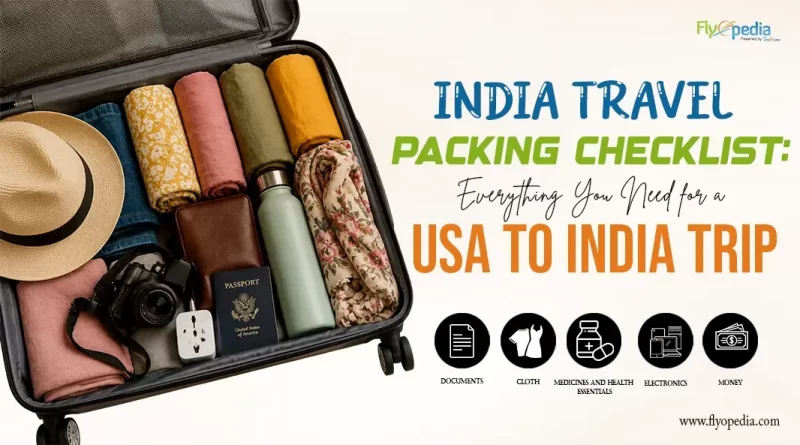
India Travel Packing Checklist: Everything You Need for a USA to India Trip
Most people traveling to India from the USA either overpack or forget something important. That’s why we have created an India travel packing checklist. A long flight with the wrong shoes, no adapter, or missing paperwork at immigration isn’t the start anyone wants.
This India packing list is built specifically for US travellers. It covers documents, clothing, medicines, electronics, and other travel essentials for India that generic packing lists often overlook.
Before you start packing, finalize your flight. Book cheap flights to India from USA on Flyopedia across multiple airlines and dates. Nail down the itinerary before you start packing, once you know your actual departure date, the packing list for India writes itself.
India Travel Packing Checklist: What to Pack for Your Trip
Use this India travel packing checklist before every trip to avoid forgetting important travel documents and essentials.
Documents – Get These Right First
Everything else on this India packing list matters less than your documents. Get these wrong and the trip doesn’t happen.
Your US passport must be valid for at least six months beyond your travel dates. Indian immigration enforces this strictly. A passport expiring within six months of arrival can result in being turned away at check-in.
You need either a valid Indian visa or an OCI card to enter India. Tourist e-visas are available online through India’s official visa portal and are typically processed within 72 hours, though applying a week ahead gives you buffer time. OCI cardholders should carry the OCI card alongside their current passport as both are required together.
From October 2025, all foreign travellers entering India have the option to submit an electronic arrival form instead of the traditional paper form. Complete this before departure to save time at immigration.
Carry physical copies and digital backups of your passport, visa or OCI, flight tickets, and hotel bookings. Store digital scans in your email or cloud storage so you can access them even if the originals are lost.
Clothing – Pack for the Region, Not Just the Season
India’s climate varies dramatically by region and time of year. What works in Delhi in January doesn’t work in Kerala in July.
For most US travellers visiting India in winter (October to February), lightweight layers work across most of North India. South India stays warmer year-round – breathable cotton is more useful than anything heavy.
For temple visits, religious sites, and rural areas, covered shoulders and knees are expected regardless of the weather. Loose cotton trousers and lightweight scarves are more useful than shorts for these situations.
Two or three pairs of comfortable walking shoes are enough. One pair for daily sightseeing, one pair for evenings. Sandals or slip-ons that come off easily save time at temple entrances where shoes must be removed.
Leave expensive jewellery at home. Imitation pieces work perfectly and carry none of the risk. If you’re looking for destination-specific outfit ideas, read our India Packing List for Female Travelers guide.
Medicines and Health Essentials
Pharmacies in India are well-stocked, but having your own supply avoids searching for a chemist on your first jet-lagged morning.
Carry prescription medicines with enough supply for the full trip plus a few extra days for delays. Bring a doctor’s note explaining the medication. This matters at Indian customs for certain controlled substances.
Over-the-counter essentials worth packing: antidiarrheal tablets, oral rehydration salts, antihistamines, pain relievers, antacids, and a basic first aid kit with antiseptic cream and plasters.
Hand sanitizer and insect repellent with DEET are used daily in most parts of India. Sunscreen is worth bringing from the US — quality varies, and prices are often higher in tourist areas.
Electronics
India runs on 230V. Your US plugs won’t fit and your devices may not handle the voltage. So, pick up a universal travel adapter with surge protection before you leave. Most modern phone chargers and laptops are dual-voltage, but check the label before assuming.
A power bank earns its weight on this trip. Between GPS, Google Translate, and photography, your phone will be working harder than usual. A full day of sightseeing drains it faster than you’d expect.
Noise-cancelling headphones or earplugs make the long flight noticeably more manageable. A neck pillow is also essential. You can bring one rather than relying on what the airline provides.
No India travel packing checklist is complete without planning how you’ll pay for things and stay connected after landing.
Money and Connectivity
Most major cities in India have ATMs that accept US debit cards, though international withdrawal fees add up. Carry some Indian rupees in cash for the first day. Airport ATMs are reliable but lines can be long on arrival.
Credit cards are best for hotels, larger restaurants, and shopping areas. For local markets, auto rickshaws, and smaller shops, cash is still the standard.
Buy a local SIM card after landing in India. Airtel and Jio both offer affordable prepaid data plans at airports. Having a local number and data from day one avoids paying US international roaming rates throughout the trip.
Carry-On Checklist for Flights to India
Pack your carry-on assuming your checked bags might be delayed. It happens on long international flights. Essentials for the flight and first day in India should travel with you: documents, medicines, phone charger, a change of clothes, snacks, and a refillable water bottle for after security.
If you’re considering an upgrade for the journey, you can book cheapest business class flights to India on Flyopedia before you book economy. The comfort difference is significant, and fares vary more than most travellers expect. If you have followed this India travel packing checklist, you’ll have everything you need for a smoother journey from USA to India.
India Packing Checklist Summary
Documents
- Passport (6+ months validity)
- Indian visa or OCI card
- Electronic arrival form
- Flight tickets
- Hotel bookings
- Digital backups of everything
Clothing
- Lightweight layers
- Modest outfits for temples
- Comfortable walking shoes or sandals
- Lightweight scarves
Health
- Prescription medicines
- Antidiarrheal tablets
- ORS
- Antihistamines
- Pain relievers
- Hand sanitizer
- Sunscreen
Electronics
- Universal travel adapter (Type C/D/M)
- Power bank
- Noise blocking headphones
- Neck pillow
Money
- Indian rupees for day one
- US debit and credit cards
- Local SIM card on arrival
Final Thoughts
This India travel packing checklist helps with what to pack for India, travel lighter, and avoid common mistakes before flying from the USA.
If your dates are still open or you’re planning a spontaneous trip, check last minute flights to India on Flyopedia. Availability on USA to India routes opens closer to departure more often than most travellers expect.
FAQs
Q1) What documents do I need to fly from US to India?
A) A valid US passport with at least six months validity beyond your travel date, plus either a valid Indian visa or OCI card. From October 2025, an electronic arrival form can be submitted before departure instead of the paper form at immigration.
Q2) What should I pack for India from USA?
A) You should pack your documents, modest clothes, prescription and over-the-counter medicines, a universal travel adapter, a power bank, and some Indian currency for day one. A local SIM card on arrival saves roaming charges.
Q3) What adapter do I need for India?
A) India uses Type C, D, and M sockets at 230V. US plugs are flat-pin at 120V. You can bring a universal travel adapter with surge protection. Most modern phone chargers and laptops are dual-voltage but check before plugging in.
Q4) Should I carry cash or use cards in India?
A) Both. Cards work well in hotels, larger restaurants, and shopping areas. Cash is still standard for local markets, auto-rickshaws, and smaller establishments. Carry some Indian rupees from day one.